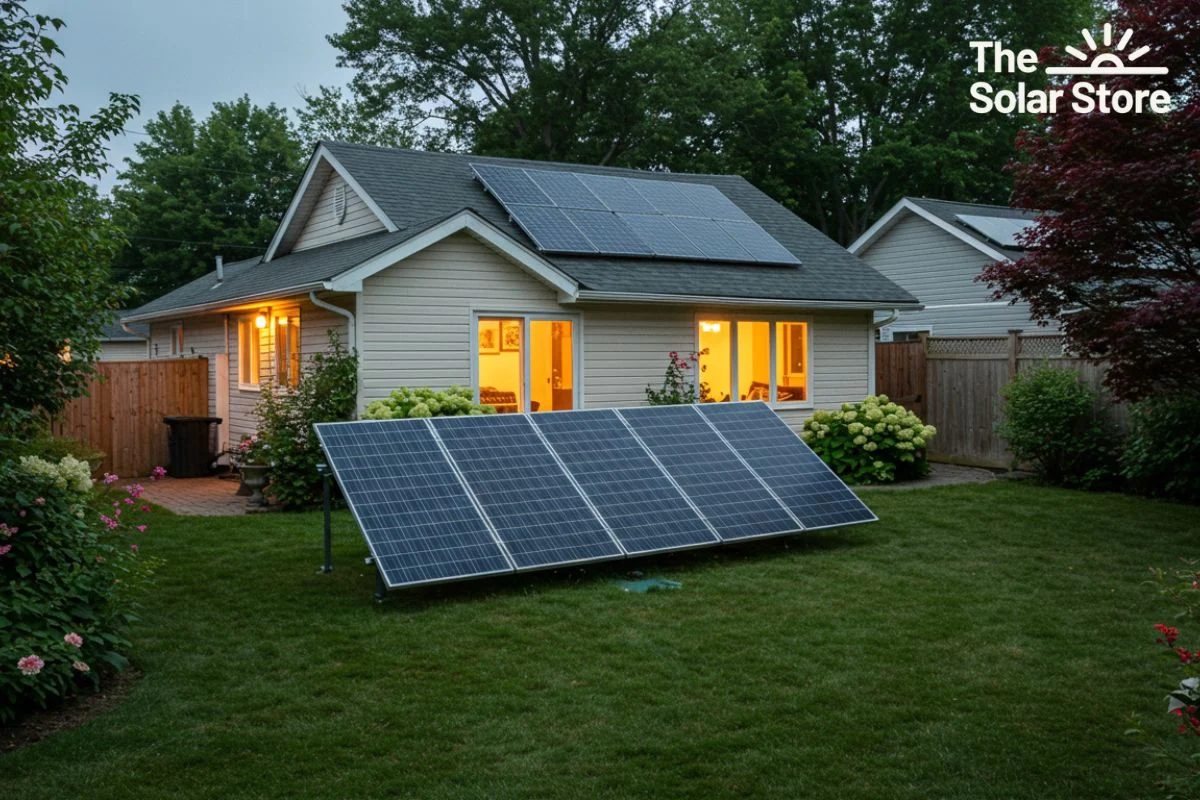
An off-grid solar system allows a home to generate and use electricity without depending on the utility grid. It uses solar panels to generate electricity, batteries to store excess energy, and an inverter to power household appliances. This makes it a useful solution for remote locations, areas with unreliable electricity, and homeowners who want greater energy independence.
However, installing an off-grid system requires more than choosing a few solar panels and connecting a battery. The system must be sized correctly to meet daily electricity use, handle peak loads, and provide enough stored energy during cloudy weather or at night.
This guide explains how an off-grid solar system works, which components you need, how to calculate the required system size, and how to choose the right setup for your home. It also explains how an off-grid solar system sizing calculator can help estimate your solar panel, battery, and inverter requirements.
Use an Off-Grid Solar System Sizing Calculator
Manually calculating solar panel capacity, battery storage, and inverter size can be time-consuming, particularly when a home contains many appliances.
An off-grid solar system sizing calculator makes the process easier by estimating the system requirements from appliance power ratings and daily operating hours.
A useful calculator should consider:
- Appliance quantity and power consumption.
- Daily operating hours.
- Total daily energy consumption.
- Peak sun hours.
- Solar system efficiency.
- Battery voltage and depth of discharge.
- Desired backup days.
- Inverter efficiency.
- Simultaneous appliance loads.
- Motor starting requirements.
The calculator should provide separate estimates for solar array capacity, battery storage, and inverter power. These values are related, but they should not be treated as interchangeable.
A calculator provides an initial design estimate, not a final engineering specification. The actual installation must account for local solar conditions, seasonal energy production, battery specifications, cable sizing, protection, and applicable electrical requirements.
What Is an Off-Grid Solar System?
An off-grid solar system is an independent electricity generation system that operates without a connection to the public electricity grid.
It generates electricity from sunlight and stores unused energy in batteries for later use. During the day, solar panels supply electricity to connected appliances and charge the battery bank. At night or when sunlight is insufficient, the inverter draws stored energy from the batteries to power the home.
Unlike a grid-connected solar system, an off-grid installation cannot rely on the utility grid when solar production is low. Therefore, battery storage and correct system sizing are essential.
Off-grid solar power systems for homes are particularly useful in:
- Remote houses without access to utility electricity.
- Rural areas with unreliable power supplies.
- Farms and agricultural properties.
- Cabins, cottages, and holiday homes.
- Locations where extending utility power lines is expensive.
- Homes seeking greater independence from electricity providers.
A properly designed system can supply electricity for lighting, fans, refrigerators, televisions, computers, water pumps, and other household appliances.
How Does an Off-Grid Solar System Work?
An off-grid solar system works by converting sunlight into usable electricity and storing surplus energy for periods when solar production is unavailable.
The process involves several stages.
1. Solar Panels Generate Electricity
Solar panels contain photovoltaic cells that convert sunlight into direct current (DC) electricity.
The amount of electricity produced depends on several factors, including:
- Solar panel wattage.
- Sunlight intensity.
- Installation angle and orientation.
- Shading from trees or nearby buildings.
- Panel temperature.
- Dust and dirt accumulation.
The panels are connected in series, parallel, or a suitable combination to provide the voltage and current required by the solar charge controller or inverter.
2. The Charge Controller Regulates Battery Charging
The charge controller manages the electricity flowing from the solar panels to the battery bank.
Its main purpose is to control charging voltage and current according to the battery’s requirements.
Two common types are:
PWM charge controller: A pulse-width modulation controller is generally simpler and less expensive. It is commonly used in smaller systems with suitable panel and battery voltage arrangements.
MPPT charge controller: Maximum power point tracking controllers adjust the operating point of the solar array to extract more available power under changing sunlight and temperature conditions. They are generally preferred for larger systems and installations where panel voltage differs from battery voltage.
Many modern off-grid inverters include a built-in MPPT solar charge controller.
3. Batteries Store Excess Solar Energy
Solar panels generate electricity during daylight hours, but household appliances may also need power at night.
A battery bank stores surplus solar energy so it can be used when the panels are not producing enough electricity.
Common battery technologies include:
- Lead-acid batteries.
- AGM batteries.
- Gel batteries.
- Lithium iron phosphate (LiFePO4) batteries.
Lithium batteries are widely used in modern off-grid installations because they generally offer higher usable capacity, better cycle life, and greater charging efficiency than conventional lead-acid batteries. However, the battery management system (BMS), operating temperature, charging limits, and manufacturer’s specifications must be considered.
4. The Inverter Supplies AC Electricity
Solar panels and batteries provide DC electricity, while most household appliances operate on alternating current (AC).
The inverter converts DC power into AC power at the voltage and frequency required by the appliances.
For example, a household inverter in a 230 V, 50 Hz electrical system must provide a suitable AC output for connected equipment.
A pure sine wave inverter is generally recommended for household applications because it produces an AC waveform suitable for a wide range of electronic devices, motors, and appliances.
5. A Backup Generator Can Provide Additional Reliability
Some off-grid systems include a petrol, diesel, or gas generator as backup.
A generator can supply electricity when several cloudy days reduce battery charge or when household consumption exceeds available solar production.
Depending on the inverter design, the generator may supply AC loads directly while also charging the battery bank.
A backup generator is not essential for every installation, but it can be useful where uninterrupted electricity is important.
Main Components of an Off-Grid Solar System
A complete off-grid solar installation requires several components that work together.
| Component | Main function |
| Solar panels | Convert sunlight into DC electricity |
| Solar charge controller | Regulates battery charging |
| Battery bank | Stores electricity for later use |
| Off-grid inverter | Converts DC electricity into AC |
| Mounting structure | Supports and secures solar panels |
| DC protection | Protects solar and battery circuits |
| AC protection | Protects household AC circuits |
| Cables and connectors | Connect system components |
| Monitoring system | Displays energy production and consumption |
Each component must be selected according to the electrical requirements of the installation. Incorrect voltage ratings, undersized cables, or unsuitable protective devices can reduce performance and create safety risks.
How to Size an Off-Grid Solar System
Correct sizing is one of the most important parts of an off-grid solar installation.
A system that is too small may run out of stored energy during the night or cloudy weather. An oversized system can increase installation costs without providing a meaningful improvement in reliability.
The best approach is to calculate daily energy consumption first, then determine the required solar panel capacity, battery storage, and inverter rating.
Step 1: Calculate Your Daily Electricity Consumption
Start by listing the appliances you want to operate and estimating how many hours each appliance runs per day.
Use the following formula:
For example, consider a small household with the following appliances:
| Appliance | Quantity | Power | Daily use | Energy |
| LED lights | 6 | 10 W | 5 hours | 300 Wh |
| Ceiling fans | 3 | 75 W | 8 hours | 1,800 Wh |
| Refrigerator | 1 | 150 W average* | 10 hours | 1,500 Wh |
| Television | 1 | 100 W | 4 hours | 400 Wh |
| Laptop | 1 | 60 W | 5 hours | 300 Wh |
| Water pump | 1 | 500 W | 1 hour | 500 Wh |
| Total | 4,800 Wh |
*The refrigerator’s actual energy consumption should ideally be taken from its energy label or measured over a full day. Its compressor does not run continuously.
The estimated daily electricity consumption is:
4,800\text{ Wh}=4.8\text{ kWh}
This means the household needs approximately 4.8 kWh of usable energy per day, before accounting for system losses and additional design allowances.
Step 2: Calculate the Required Solar Panel Capacity
The solar array must generate enough electricity to operate household appliances and recharge the batteries.
A basic sizing formula is:
Assume:
- Daily energy consumption = 4.8 kWh.
- Peak sun hours = 5 hours.
- Overall system efficiency = 80%.
Then:
The calculated minimum solar capacity is approximately 1,200 W.
In practice, installing some additional capacity may be sensible to accommodate seasonal changes, battery charging requirements, dust, high temperatures, and unexpected consumption.
For example, a 1.5 kW solar array may provide a more practical starting point for this illustrative load, subject to local solar conditions and the actual system design.
Step 3: Calculate Battery Storage Capacity
Battery capacity determines how much energy can be stored for use at night and during periods of low solar production.
The required battery capacity depends on daily energy consumption, desired backup time, battery voltage, and allowable depth of discharge.
Use this formula:
Suppose the household requires:
- Daily energy = 4,800 Wh.
- Backup period = 1 day.
- Battery depth of discharge = 80%.
- Inverter efficiency = 90%.
Then:
The battery bank should therefore provide approximately 6.67 kWh of nominal energy capacity under these assumptions.
For a 48 V battery bank:
A practical selection might be a compatible 48 V, 150 Ah battery, provided its continuous discharge rating, BMS limits, and manufacturer’s requirements support the intended loads.
For a system with two days of backup, the required nominal battery capacity would be approximately twice as large, assuming the same daily consumption and design assumptions.
Step 4: Calculate the Inverter Size
The inverter must support the total power demand of appliances operating at the same time.
Unlike daily energy consumption, which is measured in kilowatt-hours (kWh), inverter capacity is measured in watts (W) or volt-amperes (VA).
Suppose the household may operate these appliances simultaneously:
- Refrigerator: 150 W running power.
- Three fans: 225 W.
- Six LED lights: 60 W.
- Television: 100 W.
- Water pump: 500 W.
- Laptop: 60 W.
Total running load:
An inverter rated at 1,500 W or higher may be a starting point, but the final selection must also consider power factor, continuous output rating, temperature derating, and motor starting surge.
Refrigerators, pumps, compressors, and other motor-driven equipment may require significantly more power during startup.
Never select an inverter using only the sum of appliance running wattages.
Step 5: Consider Solar Charge Controller Capacity
The charge controller must be compatible with the solar panel array and battery bank.
For a simple estimate, the battery-side charging current can be calculated as:
For example, a 1,500 W solar array charging a 48 V battery bank gives:
The controller must be selected with sufficient capacity for the expected charging current and must also meet the solar array’s maximum input voltage and current requirements.
For MPPT controllers, the maximum PV input voltage is especially important. The open-circuit voltage of the series-connected panels must remain within the controller’s limit, including temperature-related increases in voltage.
Advantages of Off-Grid Solar Power Systems for Homes
Off-grid solar systems offer several benefits, particularly in locations where reliable utility electricity is unavailable or difficult to obtain.
1. Energy Independence
An off-grid system allows homeowners to generate electricity without relying on the public electricity grid.
This can be particularly useful in remote areas where connecting to the utility network is expensive or impractical.
2. Electricity During Grid Outages
Because the system stores energy in batteries, household appliances can continue operating when the utility supply is unavailable.
The available backup time depends on battery capacity, energy consumption, and the condition of the system.
3. Reduced Dependence on Fuel Generators
Solar panels can reduce the need to operate petrol or diesel generators for everyday electricity.
This may lower fuel expenses, noise, and routine maintenance requirements.
4. Suitable for Remote Locations
Off-grid solar power systems for homes can supply electricity to cabins, farms, rural properties, and other buildings without convenient access to grid infrastructure.
5. Expandable System Design
Many off-grid systems can be expanded by adding compatible solar panels, batteries, or inverter capacity.
However, expansion must remain within the limits of the inverter, charge controller, battery management system, wiring, and protection equipment.
Disadvantages of an Off-Grid Solar System
Although off-grid solar provides energy independence, it also has limitations that should be considered before installation.
1. Higher Initial Cost
Batteries and off-grid inverters can significantly increase the initial installation cost compared with a basic grid-connected solar system.
2. Dependence on Weather
Solar production decreases during cloudy weather, rain, and periods of limited sunlight.
The system must have sufficient battery storage and solar generation capacity to handle expected low-production periods.
3. Battery Replacement
Batteries have a limited service life. Their lifespan depends on battery chemistry, temperature, charging practices, depth of discharge, and operating conditions.
Battery replacement should be included in long-term system cost calculations.
4. Careful Energy Management
An off-grid system has a limited amount of stored energy. Running several high-power appliances simultaneously can quickly drain the batteries.
Homeowners may need to schedule certain appliances during daylight hours when solar production is available.
How to Choose the Right Off-Grid Solar System for Your Home
Choosing the correct system requires understanding your household’s electricity requirements rather than selecting an inverter or solar panel package based only on its advertised size.
Consider these factors before purchasing equipment.
Daily energy consumption: Calculate how much electricity your appliances use each day. Include seasonal appliances such as air conditioners and electric heaters.
Peak load: Identify which appliances may operate simultaneously and calculate their combined running power.
Starting surge: Consider the higher starting current required by motors, pumps, refrigerators, and compressors.
Battery capacity: Select enough storage for your desired backup period and account for the battery’s permitted depth of discharge.
Solar panel capacity: Use realistic local peak sun hours and allow for system losses and seasonal changes.
Battery technology: Compare lead-acid and lithium batteries based on usable capacity, cycle life, charging requirements, and cost.
Future expansion: Consider whether you may add more appliances or increase household electricity consumption later.
Safety and installation: Use suitable DC and AC protection, correctly sized cables, proper grounding and bonding, and equipment installed according to manufacturer instructions and applicable electrical standards.
Conclusion
An off-grid solar system can provide reliable electricity to homes without depending on the utility grid. It combines solar panels, batteries, charge controllers, and an inverter to generate, store, and supply electricity throughout the day.
However, system sizing is essential for dependable operation. Solar panel capacity must meet daily energy requirements, battery storage must provide sufficient backup, and the inverter must handle both running loads and appliance starting surges.
An off-grid solar system sizing calculator can help estimate these requirements and provide a useful starting point for planning an installation.
Before purchasing equipment, calculate your household’s energy consumption and consider seasonal sunlight, battery backup needs, and future electrical loads. A properly designed system can provide greater energy independence and dependable power for years.
FAQs
1. How many solar panels are needed for an off-grid home?
The number of solar panels depends on daily electricity consumption, panel wattage, peak sun hours, and system efficiency. For example, a 1,500 W solar array could use three 500 W panels, provided the panel and inverter specifications allow that configuration.
2. How many batteries are needed for an off-grid solar system?
The number of batteries depends on the required storage capacity, battery voltage, usable depth of discharge, and desired backup period. Calculate the total battery capacity first, then select compatible batteries that provide the required voltage and energy storage.
3. Can an off-grid solar system run an air conditioner?
Yes. An appropriately designed off-grid system can run an air conditioner if the inverter, solar array, and battery bank are large enough to handle its running power, starting requirements, and daily energy consumption.
4. How many days of battery backup should an off-grid solar system have?
The required backup period depends on local weather conditions, reliability requirements, budget, and the availability of a backup generator. One day may be suitable for some installations, while remote homes may require two or more days of storage.