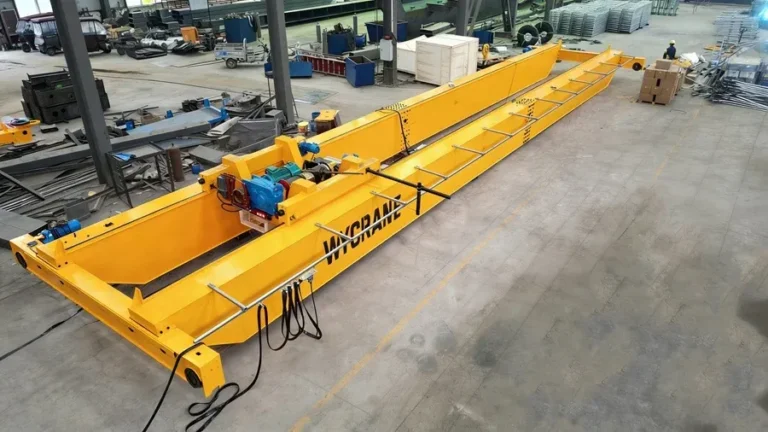
When people watch an overhead crane glide across a workshop —especially equipment produced by a leading Chinese overhead crane manufacturer— or a gantry crane lift massive loads at a port, it’s easy to focus on the steel structure and mechanical strength. In reality, the true performance driver lies in the Electrical Systems in Crane Operations. These systems coordinate motion, enforce safety logic, regulate torque, and ensure precision positioning under heavy loads. Modern cranes are no longer purely mechanical machines; they are intelligent electromechanical platforms where automation, control engineering, and protection architecture work together to deliver safe, efficient, and highly controlled lifting performance.
Understanding How Electrical Systems Enable Safe, Intelligent, and Efficient Crane Operations requires looking beyond mechanics. Modern cranes are advanced electromechanical systems powered by PLCs, VFDs, protection-rated components, safety circuits, and carefully engineered voltage configurations. Without this electrical foundation, precise and safe lifting would not be possible.
The Electrical Brain: PLC Control Systems
At the core of modern crane automation is the Programmable Logic Controller (PLC). It acts as the central decision-making unit of the crane.
A PLC in a crane does far more than basic on-off control. It constantly monitors input signals, including load sensors, limit switches, brake feedback, motor current, and emergency stops. Within milliseconds, it processes this information and determines whether the crane should move, slow down, stop, or trigger an alarm.
Modern cranes often use a layered PLC architecture:
Primary safety PLC
Handles emergency stop loops, brake monitoring, and critical limit switches.
Motion control PLC
Manages hoisting, trolley travel, bridge movement, and speed references to drives.
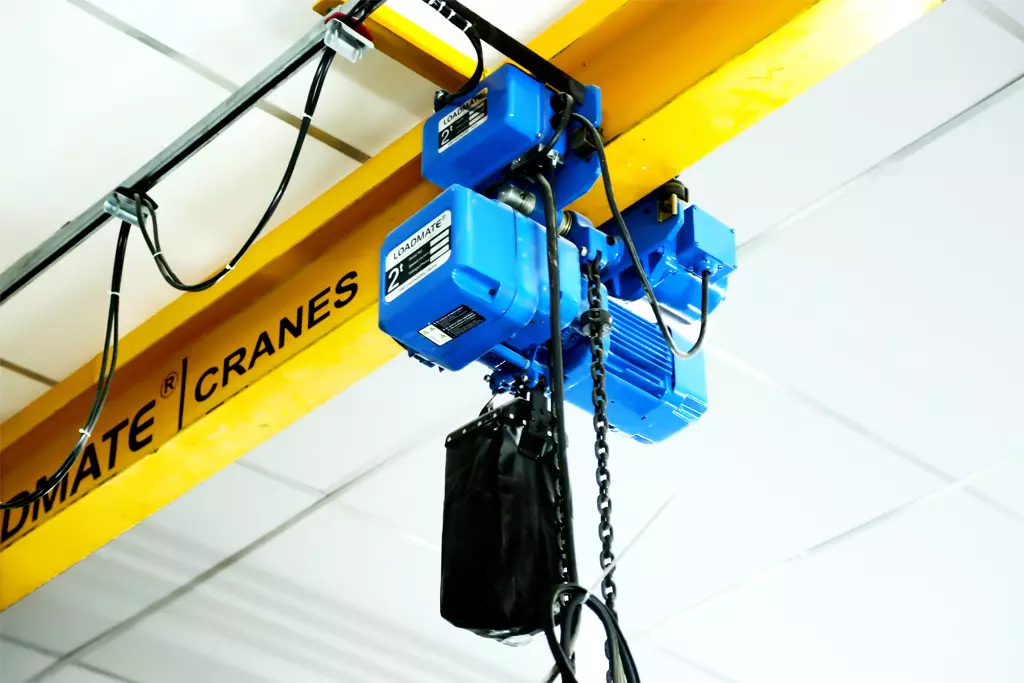
Auxiliary systems
Support diagnostics, data logging, remote monitoring, and predictive maintenance.
For example, when an operator presses the hoist button, the PLC first checks overload conditions, verifies that upper limits are not reached, confirms brake release, and then sends a controlled speed command to the drive system. If any abnormal condition appears, it instantly stops motion and re-engages the brake.
This intelligent coordination is a key reason why electrical systems enable safe, intelligent, and efficient crane operations in modern industries.
Variable Frequency Drives: Precision in Motion Control
Variable Frequency Drives, or VFDs, are responsible for controlling motor speed and torque. In older crane systems, direct-on-line motor starting caused sudden torque shocks. This led to mechanical stress, load sway, and rapid brake wear.
With VFD integration, crane motion becomes controlled and smooth.
VFDs allow:
- Crane Electrical Systems: Safe, Intelligent, and Efficient Operation
- Electrical Installation Guide: Wiring, Protection & Safety Standards
Soft acceleration and deceleration
Precise speed adjustment
Reduced mechanical shock
Lower energy consumption
Improved load positioning accuracy
Advanced VFD features used in cranes include vector control for strong low-speed torque, S-curve acceleration to reduce sway, torque limiting for overload protection, and regenerative braking to recover energy.
By shaping motor performance intelligently, VFDs significantly reduce stress on mechanical components. This directly supports efficient crane operation while extending equipment lifespan.
Protection Ratings: Surviving Harsh Environments
Cranes operate in some of the toughest industrial environments. Steel mills generate metallic dust. Ports expose equipment to salt and humidity. Cement plants produce fine abrasive powder. Outdoor cranes face rain, wind, and temperature extremes.
This is where IP protection ratings become critical.
Higher IP ratings:
Prevent dust and water ingress
Reduce short circuit risks
Protect sensitive sensors
Extend equipment lifespan
Improve reliability under harsh conditions
For example:
Steel plants often require IP55 or IP65 motors.
Outdoor gantry cranes may need IP65 or IP66 control panels.
Port cranes require corrosion-resistant housings and marine-grade connectors.
Critical sensors like hoisting encoders may use IP67 sealing to prevent moisture damage.
Without proper protection ratings, electrical failures would compromise both safety and uptime.
Multi-Layer Safety Circuits and Fail-Safe Design
Safety in cranes is never dependent on a single device. Instead, a multi-layer safety architecture ensures redundancy.
Limit switches are used to prevent over-travel in hoisting, trolley movement, and bridge travel. For hoisting, both slowdown and final cut-off limits are typically installed.
Overload protection may use strain gauge load cells, rope tension sensors, hydraulic pressure monitoring, or torque calculation through VFD data. Many modern cranes use two independent overload detection methods for added safety.
Brake monitoring is another critical feature. Electrical systems confirm that brake coils energize properly and verify that the brake physically opens. If brake slip is detected, the PLC immediately cuts power and re-engages braking.
The safety chain includes emergency stop stations, pendant stops, door interlocks, thermal overload relays, and drive safety inputs. If any part of this chain opens, the crane shuts down instantly.
This layered protection demonstrates clearly how electrical systems enable safe, intelligent, and efficient crane operations by preventing uncontrolled motion.
Global Voltage Requirements and Localization
Cranes are installed worldwide, but electrical standards vary by region. Voltage levels, frequency, grounding systems, and protection requirements differ significantly.
For example:
North America commonly uses 480V at 60Hz.
Europe uses 400V at 50Hz.
Some Asian regions use 380V at 50Hz.
Japan has mixed frequency systems.
- Complete Guide to Electronics Engineering
- Traction Control Sensor TCS: Working and Common Fault Signs
A motor designed for 50Hz will operate differently at 60Hz. Speed, torque, and thermal behavior all change. Therefore, crane electrical systems must be adapted for local voltage and frequency standards.
Localization may require:
Different motor windings
Modified VFD configurations
Adjusted protection settings
Compliance with IEC, UL, or regional codes
Proper electrical design ensures that cranes operate efficiently and safely in any country.
Component Selection and Lifecycle Reliability
Component quality has a direct impact on crane performance and lifecycle cost. Cranes experience high inrush currents, constant vibration, heavy-duty cycles, and environmental stress.
Low-quality contactors, drives, or sensors often fail early. This results in intermittent faults, production downtime, and reduced safety margins.
High-grade components offer:
Better diagnostic capabilities
Long-term spare part availability
Stable communication with PLC systems
Higher endurance under industrial stress
Since cranes are mission-critical equipment, reliability is not optional. The cost of downtime far exceeds the initial savings of cheap components.
The Future of Electrically Intelligent Cranes
As industries move toward smart factories, crane systems are becoming even more intelligent. Electrical systems are now integrating:
Anti-sway algorithms
Real-time load monitoring
Remote diagnostics
Energy optimization
Cloud-based performance tracking
The future will likely include AI-driven motion control, autonomous positioning, and digital twin integration.
All these advancements reinforce one central truth: how electrical systems enable safe, intelligent, and efficient crane operations will continue to define the next generation of industrial lifting.
Conclusion
Cranes may appear mechanical on the outside, but their intelligence, safety, and performance are driven by electrical engineering. PLCs coordinate logic and safety checks. VFDs shape motor behavior with precision. Protection-rated components survive harsh environments. Multi-layer safety circuits prevent accidents. Voltage adaptation ensures global compatibility. High-quality components guarantee long-term reliability.
The evolution of cranes is deeply connected to the evolution of electrical systems. As automation grows smarter, cranes will become even more intelligent, efficient, and secure — powered by increasingly advanced electrical architectures.
If you would like, I can now optimize this further for SEO structure, create a meta description and slug, or tailor it specifically for your website audience tone.